Saturday, October 29, 2011

The Penelopiad

Faithful followers,

You may recall that in one of my first blog posts, I mentioned Margaret Atwood's The Penelopiad as being one of my favourite novels.

Last week, Atwood's own stage adaptation of her novella came to The Stanley and the Arts Club Theatre put on an incredible show.  I went to the play with my friend Kat, who hadn't read the text before, and she was equally blown away.

I often assume that everyone knows the gist of Homer's "Odyssey", but I'm beginning to realize this isn't true.  Thanks to Brad Pitt, I think most people at least know the story behind "The Illiad", so I'll use that as my starting point.

After winning the Battle of Troy with his crafty Trojan horse plan, Wily Odysseus sets sail home to Ithaca, after 10 years of absence from his wife Penelope and son Telemachus. Instead of going straight home though, Odysseus spends another 10 years adventuring all over Ancient Greece, outsmarting a cyclops (pissing off Papa Poseidon to no end), withstanding the songs of sirens, and shacking up with the Goddess Circe on her island, to name a few.  Meanwhile, Penelope is back at home in Ithaca with a "hardened heart", warding off hundreds of suitors eating her out of house and home and trying to convince her that her husband is dead.  Penelope is the definition of loyalty, never losing faith in her husband's returning, and earning her own epitaph, "clever", with tricks like her never-ending shroud.  In the end, Odysseus finally returns home and kills everyone, including 12 maids of Penelope's who been particularly skanky with the suitors.  P and O go to sleep in their special treetrunk bed, dawn with her red rose fingers dances across the sky and so end "The Odyssey".

In Atwood's The Penelopiad, however, the story takes a decidedly different take on the events of Homer's tale, with a deceased Penelope telling HER side of things down from Hades.  The essential difference in Atwood's text is that the 12 maids are in fact Penelope's most trusted confidantes, hanging with the suitors on her command, helping her weave and unweave the shroud, and being basically like daughters to Ithaca's Queen.  Penelope is therefore heartbroken when unbeknownst to her, her beloved maids are hanged by her own son before she can explain to her husband what a help they were to her.  The maids take a main role in Atwood's text, narrating hilarious scenes like "The Trial of Odysseus"  and giving a lecture on phallic imagery in Odysseus' return to Ithaca.  They are incredibly haunting characters as well, following Penelope around in Hades, "floating" rather than walking, their feet still "twitching"- the term immortalized in Homer's original.

Those of you who know me best know I LOOOVE to get my Feminism on, and this novella suits me so fine.

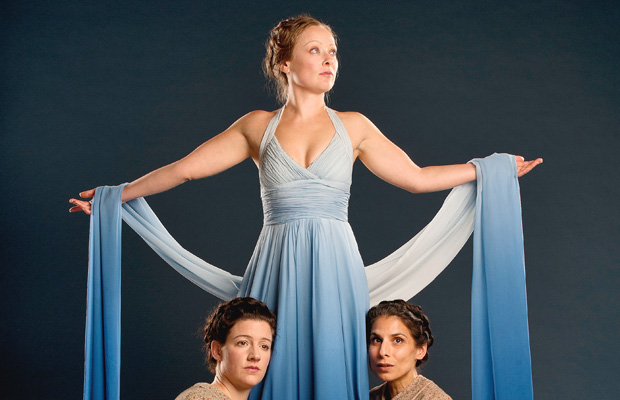
I was so excited to find out that "The Penelopiad" was coming to Vancouver, and that it was Atwood herself who had adapted her original work for the stage.  The play features an 11 person, all female cast, Vancouver's staging starring Meg Roe as Penelope.  The remaining 10 women all play maids, but additionally play other characters, including male ones such as Penelope's father, her son Telemachus, and of course, Wily O.  The actresses featured in the Arts Club's production were so incredibly talented, and I was especially impressed with their ability to portray masculine characters.

Another aspect of the play that I adored was the musical excerpts included throughout.  Penelope and her maids sing a haunting lullaby to Telemachus, an effective round while they weave and unweave at the dead of night, and as raucous sailers sing a ballad on O's exploits.  There was a violinist in the cast, another woman played guitar, there was often additional percussion instruments involved in the songs, and oh my goodness could these ladies sing!!! Sometimes the pieces were in 4 part harmony, and they were gorgeous!  I am so incredibly picky when it comes to vocal music, so you can be assured that if I'm saying these gals were good, I really, really mean it.

Check out some of the pics, and a video "trailer" from the Arts Club production.  It runs until Nov 20th, and if you have a chance I whole-heartedly recommend seeing it.  If thats not a possibility for you, at least read Atwood's book!


Friday, October 21, 2011

A Novel in Five Hours

I have just completed my first adventure into the world of Douglas Coupland.  I've spent the last couple days mostly curled up on the couch, going through boxes of kleenex, watching Say Yes to the Dress marathons, and reading Coupland's Player One: What Is to Become of Us. Proclaimed at the bottom of the front cover as "A Novel in Five Hours".  It is indeed structured as such, hours 1-5, and narrated by 4 characters stranded in a seedy airport hotel bar during a global disaster.

Kathy, a divorced mom looking for a second shot at love, Rick, a divorced alcoholic tending bar at the lounge, Luke, an ex-priest turned criminal, and Rachel, a physically gorgeous, emotionally and mentally complicated 20 something looking to have a baby, all end up stuck in Rick's bar when oil hits a whopping $900 per barrel and the world as they know it goes absolutely to shit.

Along with these 4 characters, the novel is also narrated by "Player One" a disembodied voice that exists in the computer world, and knows everything.

Coupland's novel is eerie, and post-modern, but not preachy or annoying. I daresay I enjoyed it very, very much, but I can recognize that I might be a minority audience in this feeling.


Through his 5 narrative voices, Coupland launches an inquisition in to too many hot topics to count: Religion, Technology, Relationships, Time, Society, Identity....the list goes on.  And while it doesn't offer many answers to any of the proposed questions, Coupland's novel certainly gets you thinking.  

Get this though- it has a happy ending!  Yes, "the New Normal" is depicted in a not altogether positive light, but the characters that I got surprisingly attached to all came out of their shared-disaster-experience THANG alright.  Then after the story there's a hilarious "Future Legend" of terms, that also includes clever little references to the plot and characters preceding it.  For example:

Time Snack:

Often annoying moments of pseudo-leisure created by computer when they stop responding in order to save a file, to search for software updates, or, most likely, for no apparent reason.

Torn-Paper Geography

The phenomenon in which, if you take a sheet of paper and rip it in half, both pieces will probably resemble and American state or Canadian province...

Pope Gregory's Day-timer

Doesn't mean anything in particular, but it certainly would have been interesting to see.


I'm having trouble discussing this Player One without giving too much away...think Woolf meets Hemingway meets that t.v. show Jericho meets Canada meets the Dystopian lit genre, and if you're still interested, let me know and I'll lend it to you!


plus


plus


plus


plus

equals


Thursday, October 6, 2011

The Solitude of Prime Numbers

The women on my mum's side of the family have a great book and magazine sharing system, and my grandma (aka, the gma or the matriarch) is the hub.  Whenever we visit, there's a massive stack of magazines on the coffee table, and much more to my delight, a magical table in her upstairs bedroom covered in all sorts of literary goodies.

My mum and her 3 sisters all have pretty exceptional taste in books, and that upstairs-table at my grandma's is a never-ending source of reading material.  Every time I go over for a visit at my Gma's I come home with new reads.

This weekend, I brought home Paolo Giordano's The Solitude of Prime Numbers.


It was a really quick and easy read- I finished in about a day and half.  It was certainly a change of pace from the Austen novel that preceded it, and because of this I think I enjoyed it all the more.
Giordano's novel is a story of two "prime number" type characters, Alice and Mattia of Italy.  

The title of the text provides a context for the lives of these two characters, who are prime numbers in that they never quite fit in with society as a whole.  Mattia, who grows up to be a successful mathematician, at one point wonders if the two can ever be "prime pairs", prime numbers with only one other number between them, like 5 and 7 or 11 and 13.  These numbers are alone together, less lonely than the higher prime numbers, where pairs get less and less frequent. 


The novel begins with sections on both 6 year old Alice and 6 year old Mattia, when the main characters both experience a childhood trauma that impacts the entirety of their lives.

Mattia suffers from the loss of his identical twin sister, and Alice has a ski accident, experiences that leave the protagonists emotionally and physically crippled, respectively.  Mattia's childhood commits him to a seriously anti-social lifestyle, while Alice's leads to an eating disorder and a dangerous need to feel accepted by her peers.  

Alice and Mattia meet in high-school, forming a somewhat inexplicable bond that neither of them can shake off, even when Alice gets married and Mattia leaves Italy for a research position out of the country. 
Giordano's text is a really well-written character-study that examines the sometimes underestimated impact of childhood experiences on one's life.  The plot is entirely believable (something I really appreciate in a novel), and is simple enough that Giordano's readers are able to focus on the characters themselves and how they deal with their lives, rather than the WHAT of what happens to them.  


If you're looking for entertaining, escapist literature, this book is not the way to go.  It is at times slightly depressing, and constantly inspires introspective thinking.  If this is a reading goal that intrigues you however, I highly recommend Giordano's book and the innovative writing it presents.


Also, Paolo is a hottie.
...and he's only 7 years older than me!
                              

Can you say "crushing"?

Tuesday, October 4, 2011

"Now a Major Motion Picture"

Dear followers and random stumblers-by,

I'm afraid I've been away from the blog world for a while! Now that I've had a month to get my new "you're-not-a-student-anymore" life all sorted our, I hope to be frequenting the blogspot crooks and crannies more often.

Tonight's post is not so much inspired as straight up developed by the lovely Miss Ashley, who suggested I write a post on novels turned movies.

Interestingly enough,  3 of my english courses at UBC, 2 of them from my last semester, dealt with that hot-topic.  I wrote a paper on Disney's adaptation of Perrault's Cinderella for my Children's Lit course, and in both my Victorian and Dystopian lit classes, we often had the opportunity to watch film versions of the texts we were studying and respond to them.  Both classes came to the similar conclusion that good adaptations are a rare gem.


First person narratives turned films specifically rarely-if ever- work out.  When you have a story written in the "I did this, I did that" style, screenwriters often jump to the horrendous overdubbed narration option.  It works in Grey's Anatomy.  I hate it almost everywhere else.

This issue is even more of a complication for screenwriters when a novel has multiple narrators.  One of the examples from my Victorian Lit class is Wilkie Collins' The Moonstone.  As a class, we all though the BBC film version of this "first detective novel" did it a huge disservice in having to erase the several narrative voices included in the text.

A more recent and topical example is Kathryn Stockett's The Help.  My mom and I agreed to read novel before seeing the movie, and I'm quite glad that I remained true to this pact.  The Help has 3 narrators, Aibileen, Minny and Skeeter, but the movie only uses Aibileen's voiceover as a narration.  My only real complaint of the movie is that this decision causes the audience to lose a lot of the Stockett's characterization of Skeeter and Minny that is so well deveoped in the novel.  The biggest contrast I noticed, and one that nagged at me throughout the late night showing of the film that I saw with my cousins, was a discrepancy in Minny's character.  You know that Avenue Q song, "Everyone's a Little Bit Racist"? Well, in Stockett's novel, the uppity white women of Jacksonville, Mississippi aren't the only ones with racist tendencies.  Its done in a very subtle and well-executed way, but still apparent in the text version of this story, Minny is presented as being similarly prejudiced towards the white people who have prejudices against her.  That complex layer to the novel made a much stronger statement than the movie's "white people are mean" one. (Sorry).

That said- the movie is still very good! I almost think I would have enjoyed it more however, if I hadn't read the book first.  And lets be clear, the book was still better.  As tends to be the rule.


To go general again, as much as first person narratives are difficult to transfer over into film, limited omniscient p.o.v's (where the reader is privy to one character's thoughts, but one one) can be equally challenging.  How do you show a character's thoughts in a movie without doing the silly voiceover thing? With difficulty.  Some movies though, have managed to do it.  Harry Potter.  Case in point.

I just finished reading, for the first time.  Jane Austen's Pride and Prejudice. What a fabulous read! If any of you haven't read it yet- do it.  It is SOOOOO much better than the movie! It goes into so much detail, and wow, it was just great.  The 2005 Keira Knightly version of the novel is a nice "filler", in that it does a lovely job of showing off the English countryside and fancy dress, and it makes me love Mr. Darcy a bit more than just words on a page can do.


 (or actually watch him walk across the field.)


In the end though, I have to conclude that the best movies are made from objectively-written novels.


Lord of the Rings baby.  LOTR.  

Thursday, September 15, 2011

Seamus Heaney: Human Chain

I don't feel like analyzing tonight, just sharing.

At my last Chapters visit I scored 3 Victorian novels (A Tale of Two Cities, Far From the Madding Crowd, Pride and Prejudice) and 2 books of poetry, one being Seamus Heaney's 2010 publication, Human Chain (the other being a Margaret Atwood collection with a fox on it that I can't remember the name of at the moment....).

I haven't made my whole way through Heaney's collection yet, but I'm very taken with the first poem, "'Had I not been awake'".    As I said, no analyzing, just sharing.  And here I go.


'Had I not been awake'

Had I not been awake I would have missed it,
A wind that rose and whirled until the roof
Pattered with quick leaves of the sycamore

And got me up, the whole of me a-patter,
Alive and ticking like an electric fence:
Had I not been awake I would have missed it,

It came and went so unexpectedly
And almost it seemed dangerously,
Returning like an animal to the house,

A courier blast that there and then
Lapsed ordinary.  But not ever
After. And not now.


Make of it what you will.  At the very base of all things poetical- isn't that the point?

Saturday, September 10, 2011

Tennyson's "Ulysses" and Halley's "Untravelled Worlds"

I'm blogging from my iPod followers!

This is the first time I've done this, so it's quite exciting. I've spent that last day or so up at Timberline Ranch in Maple Ridge, on retreat with the Surrey Children's Choir for my first go in my official capacity as their new general manager. It's been a great weekend so far, filled with the the typical, cliched standards of music and laughter. I'm incredibly impressed with this new, young group. Their sight-reading is decent, they've got a fair bit of gusto when it comes to singing things like showtunes or, you know, Jerusalem, and their unison sound is the classic scc blend of beautiful.

For a good few years now, I've been very intrigued by the connection between music and literature, fuelled hugely by the mentorship of my highschool IB English teacher, Ronnie Haggarty. It's a wonderful thing that music can take already beautiful poetry and push it just that much further towards the edge of sublime.

Take for example, Tennyson's "Ulysses" and what a brilliant thing Paul Halley did with it in his composition "Untravelled Worlds".  Halley manages to match melodies with Tennyson's lyrics that lift the words to new levels, allowing for what I would argue is an even stronger connection with the poetry.  I think the most beautiful example is Halley's setting of the line "Yet all experience is an arch wherethrough/ Gleams that untravelled world, whose margin fades for ever and for ever/ When I move".

On the words "wherethrough gleams that..." Halley writes an ascending melodic line that breaks into a beautiful 3 part chord, topped with the highest notes the song has seen to this point.  Then just as the notes moved in an upwards motion as if to create the first half of an arch-like shape, the melody than subtly returns back to the midrange, both completing the arch AND evoking the feeling of a "fading margin" with each chromatic step.  Bam.

Pages later, Halley accompanies the word "silence" with brief phrases punctuated by eighth note rests.  The line from the poem is actually "...every hour is saved/ From that eternal silence"; the fact that the silences are brief, with short melodic lines seemingly breaking through it, mirrors Tennyson's vision of Ulysses/Odysseus seeking an extended, never ceasing life of excitement. At the end of this line, the melody extends the words with a triplet-like feel,  giving a sense that this wish has been or will be fulfilled.

Even something as simple as setting the words "sinking star" to a descending line from the 5th to the 3rd of the chord is a great example of Halley's bringing words to life.

If you haven't read this poem before, you should.

If you haven't heard the song before, you should go to the Grand Opening of the new Surrey City Centre Library on September 24th and hear the Surrey Children's Choir perform it in those fabulous acoustics!!

Ithaca- Ulysses' hometown.

Sunday, August 21, 2011

Summer Reads.

I just spent about 3 hours on and off writing a blog about the crappy novels I read at the lake this summer.  When I went to post it, it disappeared.

I LOVE TECHNOLOGY!

I won't write it out again, I can't be bothered.  I'll just leave you with the conclusion that I came to in the end:


A warning to readers: When at the lake, instead of reading easy, shitlit, its probably best to read nothing at all, and just get wasted instead.